Should you lubricate garage door rollers and tracks?
Light lubrication of hinges and roller stems can help a garage door run quietly, but tracks generally need cleaning rather than lubricating. Use a lubricant made for garage doors and follow your door manufacturer's instructions. Never lubricate or touch springs, cables, drums, or bottom brackets. They are under high tension, and that work belongs to a trained technician.
Lubricating a garage door is one of the few maintenance jobs homeowners can do safely, but only if it is limited to the right parts. Spraying the wrong area, or using the wrong product, can attract dirt or put you near components under dangerous tension. This guide explains what to lubricate, what to clean instead, and what to leave to a technician.
Key Takeaways
- Rollers and hinges are the main moving parts a homeowner can lubricate.
- Tracks should usually be cleaned of dirt and debris, not coated with oil or grease.
- Too much lubricant attracts dust and grime, which can make noise worse.
- Springs, cables, and drums are never a homeowner job.
- A door that stays noisy after lubrication likely has a worn part.
Why Rollers and Tracks Need Attention
Every time a garage door opens, its rollers travel along the tracks while hinges flex at each panel joint. In Southwest Florida, humidity and salt in the air add moisture and corrosion to that constant motion. Dry, dirty, or rusting hardware creates friction, and friction wears parts out faster and puts extra strain on the opener.
Lubrication reduces that friction. But it only helps if it is applied to the right places and the surfaces are clean first.
What to Lubricate and What to Leave Alone
Not every part benefits from lubricant. In some cases it does harm. The table below shows the general approach. If your door manufacturer’s instructions differ, follow them.
| Part | General Approach | Who Should Do It |
|---|---|---|
| Hinges | Light lubrication at the pivot points | Homeowner |
| Roller stems and bearings | Light lubrication where metal moves on metal | Homeowner, if rollers are in good shape |
| Tracks | Clean off dirt and debris; avoid heavy grease | Homeowner |
| Springs | Lubrication is part of a professional tune-up | Professional only |
| Cables and drums | Do not touch | Professional only |
| Bottom brackets | Do not touch | Professional only |
Nylon rollers vary by manufacturer, so check your door’s guidance. If a roller is cracked, wobbling, or flat-spotted, lubricant will not fix it. That is a job for roller replacement.
Choosing a Lubricant
Use a product designed for garage doors. Eddie’s Garage Door technicians use a weather-resistant silicone spray, which does not turn gummy the way some oils can. Thick grease collects dirt, and general household oils may not hold up to Florida heat.
A little goes a long way. A light coat is enough. Wipe away any extra so it does not drip onto the floor, the door panels, or your vehicle.
A Simple Routine for Hinges and Rollers
Work with the door fully closed, and the opener disconnected from power if you will be near moving parts. If you are not sure how to do that, skip the job and let a technician handle it.
- Clean first. Wipe the tracks with a dry or lightly damp cloth to remove dust and old residue.
- Look for damage. Check for cracked rollers, bent track edges, and rust. Do not lubricate damaged parts.
- Lubricate lightly. Apply a small amount to hinge pivots and roller stems where metal moves against metal.
- Wipe off the excess. Clean up any drips before running the door.
- Cycle the door a few times. Listen for any remaining noise.
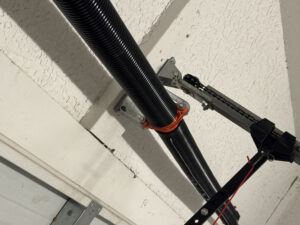
Stay clear of the springs, the cables, and the brackets at the bottom corners of the door. These parts hold the door’s weight under high tension. The Door and Access Systems Manufacturers Association states that springs and cables are dangerous components that trained technicians should handle.
When Lubricant Will Not Solve the Problem
If the noise or shaking remains after you have cleaned and lubricated, the problem probably is not friction. Tracks may be bent or out of alignment, rollers may be worn out, or the door may be out of balance.
Here are the signs to stop and call for help.
- The door scrapes against the track or jumps while moving
- A track looks dented, loose, or visibly out of line
- The door tilts to one side or moves unevenly
- The opener strains or the door feels heavy
Bent or misaligned tracks need track repair and alignment. A door that has left its track completely is an off-track door and should not be operated.
Let a Technician Handle the Hard Parts
A professional tune-up covers areas homeowners shouldn’t touch, including lubricating springs, tightening hardware, and a balance and safety check. Eddie’s Garage Door is licensed, insured, and family-owned, and we provide free, upfront estimates with same-day service for many repairs. Our preventive maintenance and tune-ups are designed to do the job completely and safely. Request a free estimate or call (239) 955-0708.
How Often Should You Lubricate?
There is no single schedule that fits every door. Doors that run often, older doors, and doors exposed to salt air and humidity tend to need more attention. A good approach is to check the hardware during each fall and spring walk-around, and lubricate lightly if parts look dry or sound rough.
Eddie’s Garage Door recommends professional service at least once a year. For older systems, a twice-yearly check is ideal. For more on why regular care matters, read the importance of regular garage door maintenance and tuning.
Smooth Rollers, Quiet Tracks, Safer Operation
Lubrication is a small job when it is done correctly, and a quick call when it is not. If your rollers and tracks need more than a wipe and a light spray, Eddie’s Garage Door can inspect the system and give you an upfront estimate. Request a free estimate or call (239) 955-0708 to schedule service anywhere in Southwest Florida.
Frequently Asked Questions
Should I lubricate garage door tracks?
Generally, no. Tracks should be kept clean, since oil or grease can collect dirt and make rollers stick. Wipe out dust and debris, then lubricate the hinges and roller stems lightly. Follow your door manufacturer’s instructions if they differ.
What is the best lubricant for a garage door?
Use a product made for garage doors. Eddie’s Garage Door technicians use a weather-resistant silicone spray. Avoid thick grease, which attracts grime. Apply sparingly and wipe off any excess so it does not drip.
Can I lubricate the springs myself?
No. Springs hold the door’s weight under high tension, and working near them can cause serious injury. Spring lubrication is part of a professional tune-up and should be left to a trained technician.
My door is still noisy after lubricating it. What now?
Persistent noise usually means a worn or damaged part, such as a cracked roller, a misaligned track, or an out-of-balance door. Stop using the door if it moves unevenly, and schedule an inspection to find the cause.
Do you service garage doors across Southwest Florida?
Yes. We serve Lee, Collier, Sarasota, Manatee, Hillsborough, Pinellas, Charlotte, and Pasco counties within a 60-mile radius of our Fort Myers and Estero locations, including Cape Coral.